Spiral Drill Rods are essential drilling tools in coal mining, geological exploration, and piling projects. But even the best drill rods will fail early — or cause downhole accidents — if used improperly or poorly maintained. This article starts with the main types of spiral drill rods, then uses seven real-world cases to explain the seven core rules of proper use and maintenance. The goal: help field engineers and operators extend drill rod life and ensure safe operations.
Overview of Main Spiral Drill Rod Types
Case 1: Precise Selection — Control Operating Parameters
Background: A coal mine used a ZDY3200L drill rig (rated torque 3,200 N·m) for gas drainage holes. To speed up, the crew replaced the matching Φ73 mm high-efficiency spiral rods with Φ89 mm heavy rods — thinking "thicker and stronger is better."
Problem: At 180 meters, the rig showed clear overload. Hydraulic pressure stayed high. The connection made abnormal noises. Inspection revealed severely worn threads — plastic deformation on the male connector, galling on the female.
Cause: The Φ89 mm rods required 3,800–4,200 N·m — well above the rig's 3,200 N·m limit. Small rig with big rods forced the rig to run overloaded. Insufficient torque caused abnormal alternating stress at connections, accelerating thread fatigue.
Correct practice:
Before work, check rig rated torque against rod rated torque range.
Match rod size to rig capability: big rig can use small rods, but small rig must not use big rods.
This case should have continued using Φ73 mm rods (rated 2,800–3,500 N·m).
Data comparison:
Case 2: Proper Matching — Avoid Drilling Failures
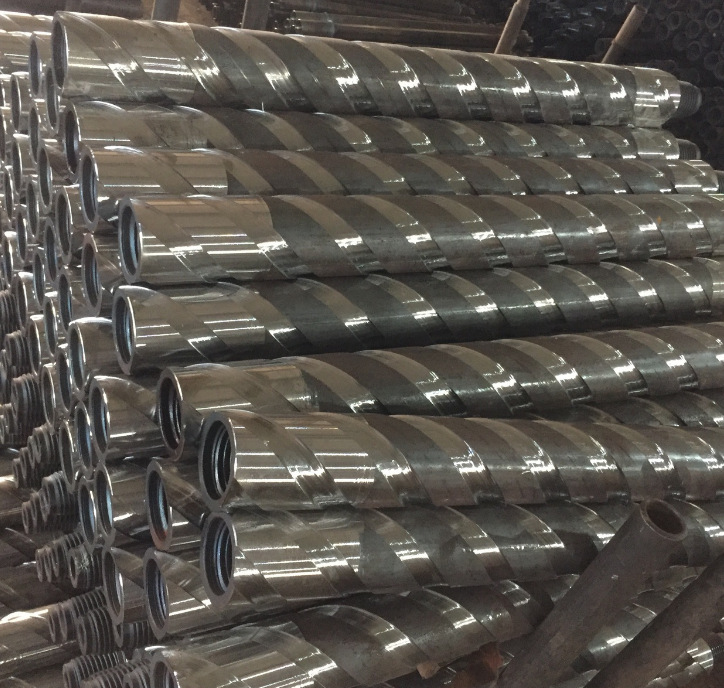
Background: A construction site used a long spiral rig for CFG piles. Rod diameter Φ400 mm. Due to bit shortage, they temporarily used a Φ350 mm bit.
Problem: At 12 meters, torque suddenly spiked, then severe vibration. Pull-out revealed badly worn lower flights — some detached — and a bent rod body.
Cause: Bit diameter (350 mm) smaller than rod diameter (400 mm) — a "reverse step." The rod flights directly contacted and scraped the hole wall, taking Cutting and chip removal loads meant for the bit. Flights overloaded, wore out, then detached. The rod body bent.
Correct practice:
In normal conditions, bit diameter should be slightly larger than rod diameter (typically by 10–30 mm).
The bit clears the path; the rod only transmits torque and removes chips.
If bits are out of stock, stop work — do not use undersized bits.
Data comparison:
Case 3: Seal Integrity — Maintain Sealing Components
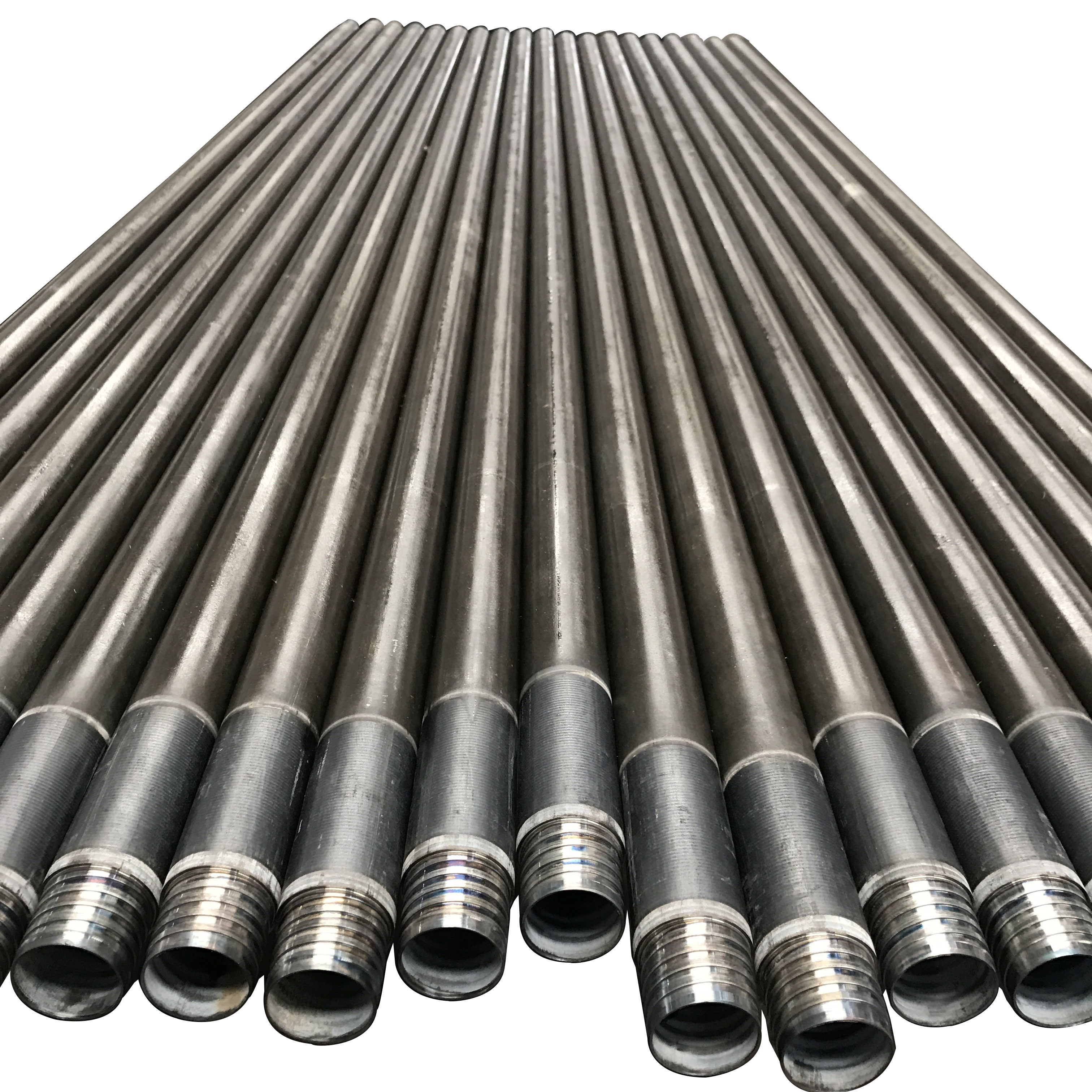
Background: A hydrogeological drilling project used water-through geological spiral rods with O-rings. At 220 meters, return water flow suddenly dropped. Bit cooling insufficient — penetration rate fell sharply.
Problem: Pull-out inspection found O-rings at connections severely aged and partially cracked. Seal failure caused high-pressure water to leak at connections instead of reaching the bit — poor cooling and chip removal.
Cause: The same rod set had already completed 3 holes (about 650 meters) without ever changing O-rings. Under long-term high-pressure water flow and underground humidity, rubber O-rings aged rapidly, lost elasticity, and cracked.
Correct practice:
Before water/air drilling, check seals at all connections.
Track seal replacement: change O-rings every 200–300 meters or every 2–3 holes.
After each drilling shift, clean seal surfaces to remove mud and debris.
For rods stored long-term, seals age — replace before reuse.
Maintenance data:
Case 4: Proper Connection — Control Drilling Depth
Background: Underground gas drainage drilling using Φ73 mm high-efficiency spiral rods. A new worker did not hand-start the connection — directly used rig power to "ram" the male connector into the female.
Problem: After 15 minutes, abnormal noise at connection, then severe torque fluctuation. Inspection revealed first two threads of female connector severely damaged; male threads also had marks.
Cause: Direct power make-up (no hand alignment) caused cross-threading — the male and female threads struck at an angle, damaging them. Damaged threads cannot distribute load evenly.
Correct practice:
Hand-align before power make-up — ensure coaxial alignment.
Hand-thread 2–3 turns, confirm smooth, then use rig power.
Control make-up torque per rod manual — never over-torque.
Also, never drill beyond rod's rated depth limit. In one case, Φ63.5 mm rods rated for 300 m were forced to 420 m — rod broke; fishing took 72 hours.
Accident cost comparison:
Case 5: Timely Repair/Scrap — No Defective Rods in Service
Background: A quarry used long spiral rods for blast holes. One rod developed slight bending (about 0.5°/m). The crew thought "not a big deal" and kept using it.
Problem: At 25 meters, the rod broke at the bent section. The broken section stayed in the hole. Hard rock made fishing impossible — the hole was abandoned. Re-drilling caused a 3-day delay.
Cause: A bent rod creates centrifugal force when rotating, causing vibration. Vibration accelerates fatigue crack growth at the bend. Industry standard: rod straightness deviation ≤0.3°/m — this case was 0.5°/m.
Correct practice:
After each pull-out, visually check straightness. Suspect areas — measure with straightedge.
If bending exceeds standard (typically 0.3–0.5°/m depending on rod type) — stop using immediately.
Slight bends can be straightened at factory; severe bends or cracks — scrap.
Keep a rod log — track cumulative footage, repairs, scrap reasons.
Straightness standard:
Case 6: Special Environment Protection — Resist Corrosion
Background: A geological exploration project in a western saline-alkali area. Groundwater had high salt content and alkaline pH. After two weeks, rods showed widespread rust and some pitting.
Problem: One more week — a rod broke at a severe pitting area. The fracture showed clear corrosion fatigue — cracks initiated at pit bottoms and grew inward.
Cause: Chlorides and alkaline substances in saline-alkali soil are highly corrosive to steel. After each shift, residual mud and groundwater on rod surfaces formed electrolyte in the air — accelerating electrochemical corrosion. Pits became stress concentrators — fatigue cracks initiated under cyclic loads.
Correct practice:
After each shift, immediately flush rods with clean water — remove all acid/alkali residues, corrosion products, and mud.
After flushing, wipe dry or air-dry — apply rust-preventive oil.
For light rust, remove with wire brush or sandpaper — assess remaining wall thickness.
Rods with pits deeper than 10% of wall thickness — scrap.
Corrosion protection data:
Case 7: Regular Maintenance — Proper Storage
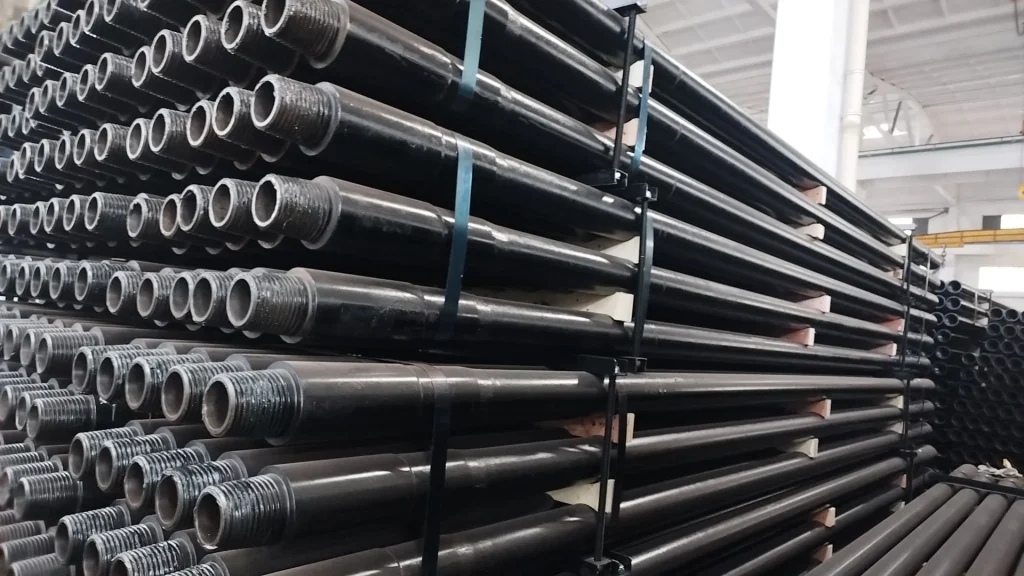
Background: A drilling company finished a large project and left 30 spiral rods in open storage — no protection. Three months later, new project started — rods were heavily rusted. Some thread connections were rusted solid and could not be made up.
Problem: New project delayed 5 days. Rust removal and repair labor cost over 20,000 yuan. 8 rods were scrapped due to severe rust — direct loss about 40,000 yuan.
Cause: Open storage exposed rods to rain, snow, sun, and humid air. Acid in rain plus oxygen accelerated rusting. Thread areas rusted worst — crevices trap moisture and dry slowly.
Correct practice:
Establish regular maintenance: every 30 days or after each project — full maintenance cycle.
Maintenance steps: clean → derust → inspect → apply rust-preventive oil → install thread protectors.
Storage: after maintenance, install thread protectors, seal in boxes, store in dry, ventilated warehouse.
For long-term storage, inspect every 3 months — reapply oil as needed.
Storage comparison:
Summary: Maintenance Multiplies Rod Life
Spiral drill rods are core tools in drilling. Their service life depends not only on manufacturing quality but even more on proper use and maintenance. The seven cases cover the entire process: selection, matching, connection, sealing, depth control, inspection/scrap, special environment protection, and storage. Every case proves one thing: one proper operation prevents ten repairs; one day of regular maintenance extends life by a year.
For field engineers and operators, consider these systems:
Rod log system: unique ID for each rod — track cumulative footage, repairs, scrap reasons.
Inspection checklist: daily/weekly/monthly items — check off each.
Shift handover: each shift inspects and hands over rod condition — address issues promptly.
Training: regular training on proper rod use and maintenance.
Remember: Rods are saved, not just replaced. Every proper operation saves cost. Every neglect invites an accident.






 Phone
Phone E-mail
Comment
(0)