


Hard Rock Drill Bit
A hard rock drill bit is a specialized cutting tool designed to penetrate extremely tough geological formations such as granite, basalt, quartzite, and other highly abrasive or high‑compressive‑strength rocks. Its primary function is to efficiently break, crush, and remove rock material while maintaining structural integrity and a long service life under harsh downhole conditions.The core of a hard rock drill bit is typically made from high‑strength alloy steel that can withstand extreme torsional loads, axial weight on bit, and high impact forces. On the cutting structure, very hard materials are used, most commonly tungsten carbide inserts or polycrystalline diamond compact (PDC) cutters. These materials provide exceptional hardness and wear resistance, allowing the bit to maintain a sharp cutting edge over long intervals in abrasive formations.For roller‑cone styles, the bit features one or more rotating cones equipped with carefully spaced tungsten carbide inserts or milled steel teeth. As the bit rotates, the cones roll and crush the rock under high compressive loads. The shape, spacing, and protrusion of the inserts are optimized for hard rock, with shorter, more robust inserts to prevent chipping and breakage. Bearing systems are heavily reinforced and often sealed to keep out drilling fluids and cuttings, extending the operating life of the cones even in high‑temperature, high‑pressure environments.For fixed‑cutter designs, the bit body is usually steel or matrix material with PDC cutters mounted on blades. In hard rock applications, the cutter layout, back rake, and side rake angles are engineered to balance aggressiveness with durability. The design aims to minimize impact loading on each cutter while maximizing the rate of penetration. Cutter size, density, and exposure are adjusted to handle the high compressive strength and abrasiveness typical of hard formations, reducing cutter damage and thermal degradation.Hydraulics are another critical aspect of hard rock drill bit design. Nozzles are strategically positioned to direct high‑velocity drilling fluid toward the cutting structure and bit face. This jet action cools the cutters, removes rock chips, and prevents balling or packing of cuttings around the bit. Efficient cleaning is essential to maintain cutting efficiency, avoid excessive torque, and minimize vibration. Some designs use interchangeable nozzles to tailor flow rates and jet impact for specific formation conditions.The overall geometry of the bit—gauge diameter, gauge protection, cone profile or blade profile, and junk slot area—is optimized to provide directional stability and hole quality. Gauge pads and hardfacing protect the outer diameter from abrasion and help maintain a full‑gauge hole, which is crucial for subsequent runs and for proper casing installation. Reinforced leading edges and wear‑resistant coatings further enhance durability against the constant friction of drilling through hard, abrasive rock.When properly selected and operated with the correct weight on bit, rotary speed, and drilling fluid parameters, a hard rock drill bit delivers improved penetration rates, longer run lengths, and reduced non‑productive time. Its advanced materials and engineering allow operators in mining, geothermal, oil and gas, and construction drilling to safely and economically reach greater depths and more challenging targets within hard rock formations.
Products
Category:
-
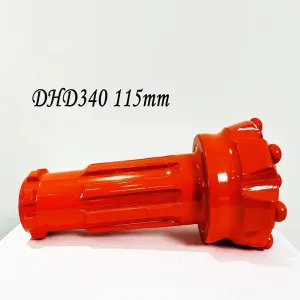
DHD340 Button Bit 115mm for Hard Rock Formations
Category: DTH drill bitBrowse number: 30Number:Release time: 2026-05-11 02:54:35Maximize drilling speed with our DHD340 115mm DTH bit. Engineered for basalt and granite mining. High durability and fast penetration. Request a price list!
News
Category:
No search results found!
Case
Category:
No search results found!
Video
Category:
No search results found!
Download
Category:
No search results found!
Job
Category:
No search results found!
Featured Products
No search results found!



 Phone
Phone E-mail