


Cutting Pick Manufacturing
Cutting pick manufacturing is a specialized industrial process focused on producing durable, high-performance tools used in mining, road milling, trenching, tunneling, foundation work, and other demanding excavation applications. A cutting pick is designed to break, chip, scrape, or cut through hard materials such as rock, concrete, asphalt, and compacted soil. Because these tools operate under extreme impact, abrasion, and heat, their manufacturing requires careful material selection, precise engineering, and strict quality control.The manufacturing process usually begins with raw material preparation. The main body of a cutting pick is commonly made from high-strength alloy steel, selected for its toughness, wear resistance, and ability to withstand repeated удар loads. The cutting tip is often made from tungsten carbide or another ultra-hard material. Tungsten carbide is widely used because it combines excellent hardness with strong resistance to wear, making it ideal for the working end of the tool. In many designs, the steel shank and carbide tip are manufactured separately and then joined through brazing, welding, or other secure bonding methods.Forging is one of the most important steps in producing the steel body of a cutting pick. During forging, heated steel is shaped under high pressure to create a dense internal structure with improved mechanical strength. This helps the pick resist cracking or bending during heavy-duty use. After forging, the part is usually trimmed, normalized, and machined to achieve the required dimensions and surface finish. Precision machining ensures that the pick fits properly into its holder and performs consistently in the field.Heat treatment is another critical stage. Through controlled heating and cooling, the steel body gains the right balance of hardness and toughness. If the pick is too hard, it may become brittle; if it is too soft, it may wear out quickly. Therefore, manufacturers carefully control quenching, tempering, and other thermal processes to optimize performance. For the carbide tip, sintering is commonly used in production. Fine tungsten carbide powder is mixed with a metal binder, pressed into shape, and heated at high temperature until the particles bond into a very hard, compact structure.After the main components are produced, they are assembled and inspected. Quality testing may include hardness testing, dimensional measurement, impact resistance checks, and visual inspection for defects. Some manufacturers also perform wear simulation to evaluate service life under real working conditions. Surface coatings or anti-corrosion treatments may be applied to improve durability and protect the tool during storage and transport.Modern cutting pick manufacturing also emphasizes consistency and customization. Different applications require different geometries, tip shapes, body lengths, and carbide grades. For example, picks used in softer ground may need different cutting angles than those used in hard rock or asphalt. As a result, manufacturers often provide a range of designs to match specific machines and working environments.In conclusion, cutting pick manufacturing is a combination of metallurgy, precision engineering, and quality assurance. Each stage, from raw material selection to final inspection, plays an important role in producing a tool that delivers efficiency, durability, and reliable cutting performance in harsh industrial conditions.
Products
Category:
-
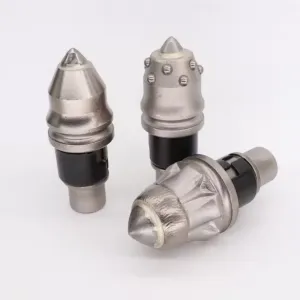
New breakthrough technologies in cutting pick manufacturing
Category: Cutting PickBrowse number: 28Number:Release time: 2025-11-18 02:50:13Advanced manufacturing technologies—such as vacuum brazing, high-precision CNC forging, and nano-coated carbide—are redefining cutting pick durability and performance. These improvements result in stronger bonding, smoother cutting action, and superior resistance to impact and thermal fatigue. As a result, mining companies benefit from more efficient excavation and lower replacement rates.
News
Category:
No search results found!
Case
Category:
No search results found!
Video
Category:
No search results found!
Download
Category:
No search results found!
Job
Category:
No search results found!
Featured Products
-
NEWS
New breakthrough technologies in cutting pick manufacturing
Learn more



 Phone
Phone E-mail