


conventional raise boring
Conventional raise boring is a widely used underground excavation method for creating vertical, steeply inclined, or near-vertical openings between two existing underground levels. It is commonly applied in mining, civil construction, and tunnel development where a safe, accurate, and efficient method is required to excavate shafts, ventilation raises, ore passes, escape ways, and service openings. Compared with blasting-based excavation, conventional raise boring offers better control, improved safety, reduced overbreak, and a smoother final wall profile.The process generally begins with the setup of a raise boring machine on the upper level of the project. A pilot hole is drilled downward to connect the upper and lower excavations. This pilot hole is usually made by a drill string and a pilot bit, which creates the initial path for the raise. Once the pilot hole reaches the lower level, a reaming head is attached to the drill string. The reaming head is significantly larger than the pilot bit and is pulled or rotated upward from the lower level to the upper level, enlarging the hole to the desired final diameter. Rock cuttings produced during this process fall by gravity to the lower excavation, where they can be removed by loaders or other material-handling equipment.One of the main advantages of conventional raise boring is safety. Since the main excavation is performed mechanically and from a protected location, workers are not exposed directly to the face of the raise during drilling. This reduces the risks associated with explosives, falling rock, and working in confined spaces. In addition, the method typically produces a stable and uniform excavation, which is especially important in ground conditions where wall quality and dimensional accuracy matter.Another important benefit is precision. Conventional raise boring can create raises with relatively accurate diameter, alignment, and surface finish. This makes it suitable for applications such as ventilation shafts, where air flow efficiency depends on the geometry of the opening, or ore passes, where smooth walls help material flow. The method is also effective in deep underground operations where access is limited and conventional drill-and-blast methods would be slower or more hazardous.However, conventional raise boring also has limitations. It requires access to both the upper and lower levels, which may not always be available. The equipment is large and expensive, and installation requires sufficient space and support infrastructure. Ground conditions also play a major role in performance. Extremely fractured, weak, or highly abrasive rock can reduce efficiency and increase wear on drilling components. In some cases, water inflow or unstable ground may create additional operational challenges.Overall, conventional raise boring remains an important and dependable underground excavation technique. Its combination of safety, accuracy, and productivity makes it a preferred choice for many deep mining and tunneling projects. As underground development continues to expand, this method will remain a practical solution for creating vertical and inclined openings in a controlled and efficient manner.
Products
Category:
-
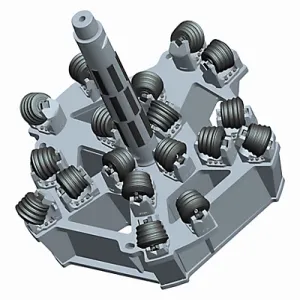
The Ultimate Guide to Choosing the Right Raise Boring Reaming Head for Your Project
Category: Raise Boring ToolsBrowse number: 25Number:Release time: 2026-07-03 10:57:58Target Keywords: Raise boring reaming heads, conventional raise boring, Sandvik RS510, Sandvik RS520, Sandvik RS530, integral reaming head, segmented reaming head.
News
Category:
No search results found!
Case
Category:
No search results found!
Video
Category:
No search results found!
Download
Category:
No search results found!
Job
Category:
No search results found!
Featured Products
No search results found!



 Phone
Phone E-mail