


efficiency of an RBM
An RBM, or Restricted Boltzmann Machine, is a type of generative neural network that is designed to learn patterns in data through a layer of visible units and a layer of hidden units. When discussing the efficiency of an RBM, it is important to consider both computational efficiency and learning efficiency. Although RBMs are not always the fastest models compared with modern deep learning methods, they remain valuable in certain settings because of their simplicity, interpretability, and ability to learn useful feature representations.One major advantage of an RBM is that its architecture is relatively simple. It contains no connections within the visible layer or within the hidden layer, only between the two layers. This restriction reduces the complexity of the model and makes some calculations easier than in fully connected undirected networks. Because of this structure, the conditional probability of the hidden units given the visible units, and vice versa, can be computed efficiently. This property makes the RBM mathematically elegant and easier to analyze than many more complex models.However, the training efficiency of an RBM is often limited by the difficulty of estimating the partition function, which is required to compute probabilities exactly. Since exact inference is usually intractable, approximate methods such as Contrastive Divergence are commonly used. These methods greatly reduce computational cost, but they also introduce approximation error. As a result, RBM training can be less stable and less precise than training some modern models that use direct backpropagation and optimized gradient-based techniques.The efficiency of an RBM also depends on the size of the dataset and the number of hidden units. For small to medium-sized problems, RBMs can learn meaningful structure reasonably well with moderate computational resources. They are especially useful when the goal is dimensionality reduction, feature extraction, or pretraining. In earlier machine learning systems, RBMs were often used to initialize deeper architectures layer by layer. This pretraining strategy improved convergence and sometimes led to better performance when labeled data was limited.Another aspect of efficiency is representational efficiency. An RBM can capture complex relationships among variables using relatively few hidden units, making it effective at compressing information into a lower-dimensional latent space. This is useful when raw data is high-dimensional but contains underlying structure. For example, binary or sparse input data can often be represented compactly by the hidden layer of an RBM.Despite these strengths, RBMs are not always the best choice for large-scale modern applications. Training can be slow, and the quality of the learned model depends heavily on hyperparameter choices such as learning rate, number of hidden units, and the number of Gibbs sampling steps. Compared with newer deep learning approaches, RBMs often require more careful tuning and may not achieve the same efficiency in large, complex tasks.In summary, the efficiency of an RBM should be viewed from multiple perspectives. It is structurally efficient, reasonably effective for learning hidden features, and computationally manageable for certain problems. At the same time, its training process can be expensive and approximate. Therefore, RBMs are efficient in specific contexts, especially for representation learning and pretraining, but they are not universally the most efficient model for all machine learning tasks.
Products
Category:
-
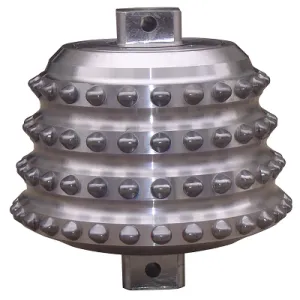
The High Cost of Unplanned Downtime in Mechanized Excavation
Category: Raise Boring ToolsBrowse number: 10Number:Release time: 2026-07-24 16:49:39In the highly specialized field of mechanized rock excavation, the Raise Boring Machine (RBM) represents a massive capital investment. The efficiency of an RBM hinges entirely on the performance of the cutting tools mounted on the reamer head. Among these, the solid tungsten carbide roller cone cutter is the primary interface between the machine and the rock mass.
News
Category:
No search results found!
Case
Category:
No search results found!
Video
Category:
No search results found!
Download
Category:
No search results found!
Job
Category:
No search results found!
Featured Products
No search results found!



 Phone
Phone E-mail