


hard rock drilling tools
Hard rock drilling tools are specialized equipment designed to penetrate very dense, abrasive, and highly compact geological formations such as granite, basalt, quartzite, and other crystalline rocks. Unlike tools used in soft or medium-hard formations, hard rock drilling tools must withstand extreme impact, high torque, severe wear, and intense heat generated during drilling. Their primary purpose is to deliver efficient rock breakage while maintaining durability, stability, and drilling accuracy under demanding conditions.A typical hard rock drilling system includes drill bits, drill rods, shanks, couplings, hammers, and related accessories. Each component plays an important role in transferring energy from the drilling machine to the rock face. The drill bit is the cutting end of the system and is usually made from high-grade alloy steel and tungsten carbide inserts or buttons. These materials are selected because they provide exceptional hardness and abrasion resistance. Button bits, in particular, are widely used in hard rock drilling because their rounded carbide buttons can concentrate impact force and resist cracking under repeated stress.There are several drilling methods used in hard rock applications. Top hammer drilling uses a percussion hammer located at the surface and is effective for smaller diameter holes and shorter drilling depths. Down-the-hole drilling places the hammer close to the bit, improving energy transfer for deeper holes and offering better straightness in hard formations. Rotary drilling systems may also be used, especially in large-scale mining and construction projects, where strong cutting and continuous penetration are required. The choice of tool depends on the rock type, hole diameter, drilling depth, and project requirements.Performance of hard rock drilling tools depends on several factors, including material quality, design geometry, heat treatment, and operating conditions. A well-designed tool should provide high penetration rate, low deviation, and long service life. Wear resistance is especially important because hard rocks can quickly dull or damage inferior tools. Proper flushing of drill cuttings with air or water is also essential to prevent overheating and to maintain efficient hole cleaning.Maintenance and correct tool selection are critical for extending tool life and reducing operating costs. Regular inspection for wear, cracks, and deformation helps prevent tool failure and unexpected downtime. Using the right feed pressure, rotation speed, and impact energy also improves performance and minimizes unnecessary stress on the equipment.Hard rock drilling tools are widely used in mining, quarrying, tunneling, foundation engineering, and geological exploration. In these industries, reliability and productivity are essential, and high-quality drilling tools make it possible to work efficiently in some of the most challenging ground conditions on earth.
Products
Category:
-
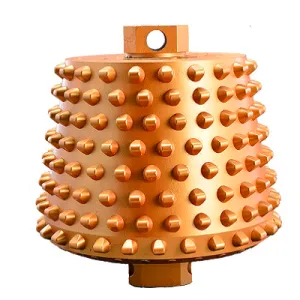
Optimizing Rate of Penetration (ROP) in Ultra-Hard Rock: A Deep Dive into Roller Cone Cutter Kinematics and Insert Profiles
Category: Raise Boring ToolsBrowse number: 4Number:Release time: 2026-07-24 15:48:20In the realm of underground mining and civil tunneling, the Raise Boring Machine (RBM) is prized for its ability to excavate shafts safely, accurately, and without the need for explosives. However, this mechanized advantage frequently hits a brutal bottleneck: ultra-hard rock.
News
Category:
No search results found!
Case
Category:
No search results found!
Video
Category:
No search results found!
Download
Category:
No search results found!
Job
Category:
No search results found!
Featured Products
No search results found!



 Phone
Phone E-mail