
In deep drilling, there is a Drill Bit that works differently. It does not rotate against rock like a conventional bit. Instead, it mounts on the front of a down-the-hole (DTH) hammer. The hammer's piston strikes it repeatedly, delivering impact energy directly to the rock at the bottom of the hole. This is the DTH bit. Paired with a DTH Hammer, it forms one of the most efficient systems for deep, large-diameter drilling.
The core advantage of a DTH bit is "energy direct." In traditional rotary drilling, energy travels from the surface through hundreds of meters of drill pipe, losing much of it along the way. With DTH drilling, the hammer is at the bottom — so almost all impact energy reaches the rock. This breakthrough makes drilling deep, large-diameter blast holes in hard rock both efficient and economical.
This article covers DTH bits in seven parts: design, pressure classification, carbide teeth, key design parameters, applications, failure modes and life management, and industry trends.
A typical DTH bit has several main parts:
The bit body is the backbone that takes impact loads and transmits torque. It is made of special alloy steel, such as SNCM439 or 40CrNiMo. After precision forging and heat treatment, it delivers:
High impact toughness — withstands thousands of piston strikes per second without brittle fracture.
Good wear resistance — survives high-velocity air and rock chips.
Adequate bending strength — resists deformation in deviated holes or fractured rock.
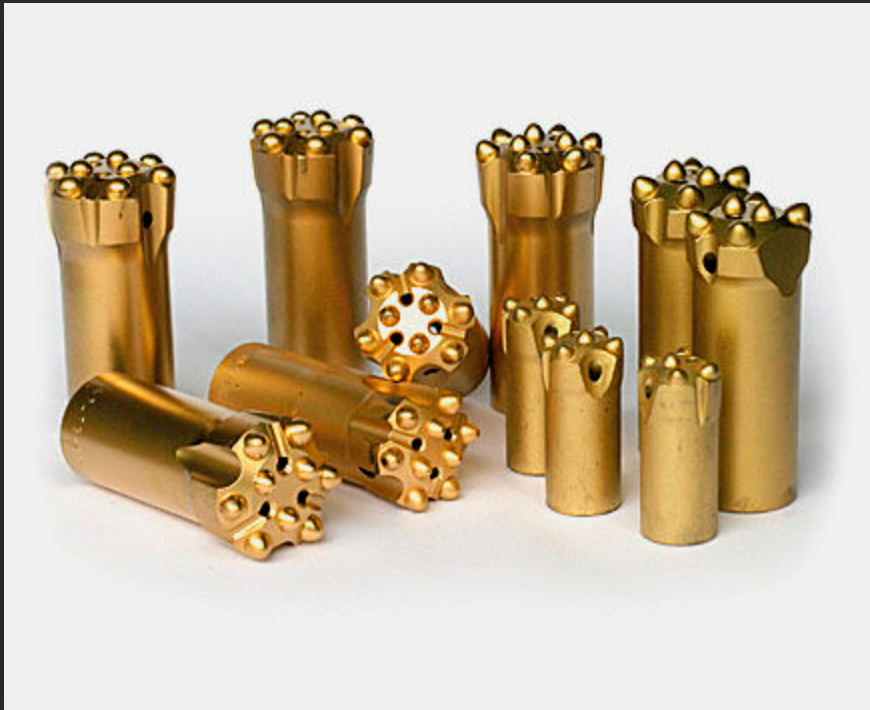

The tail of the body has splines or threads to connect with the hammer, ensuring the piston's impact energy reaches the bit head.
Carbide teeth embedded in the bit head are the actual rock breakers. Based on rock type, there are two main shapes:
Button Bits — hemispherical or conical, for hard, brittle rock; crushing-dominated.
Chisel bits (or flat-shaped) — for medium-hard and softer rock; shearing and scraping.
Air exhaust system — DTH bits use compressed air (or foam, or mud) to remove rock chips. The bit has a central hole and side exhaust ports. High-pressure air from the hammer enters the central hole, then blasts out of the face ports, blowing chips off the bottom and up the annular space between the drill pipe and hole wall.
Exhaust system design directly affects drilling speed. The number, position, and angle of ports must be precisely calculated to clear chips quickly and avoid "re-crushing."
DTH bits are divided into two main series based on the operating air pressure of the hammer.
High-pressure series — Matches high-pressure hammers. Operating pressure is typically 1.5–3.0 MPa (215–435 psi), with some ultra-high systems above 3.5 MPa. Features:
Takes higher impact energy — larger piston mass and faster strike speed.
Stronger penetration — in extremely hard rock like granite, quartzite, and basalt.
Reinforced structure — larger body and teeth, higher-grade materials.
High-pressure bits are widely used in large open-pit mines, deep blasting, geothermal wells, and large-diameter water wells.
Low-pressure series — Matches low-pressure hammers. Operating pressure is typically 0.5–1.2 MPa (70–175 psi). Features:
Lower energy consumption — smaller compressor, lower equipment cost.
Works in conventional rock — performs well in medium-hard and softer rock like limestone, sandstone, and shale.
Lighter structure — smaller body and teeth, easier to handle.
Low-pressure bits are the mainstream choice for small and medium mines, quarries, earth-rock works, and shallow holes.
| Parameter | High-Pressure Series | Low-Pressure Series |
|---|---|---|
| Operating pressure (MPa) | 1.5–3.0+ | 0.5–1.2 |
| Suitable rock | Extremely hard, hard | Medium-hard and below |
| Typical hole diameter (mm) | 90–300 | 65–150 |
| Single impact energy | High | Low to medium |
| Equipment requirement | Large compressor | Small to medium compressor |
The rock-breaking ability of a DTH bit depends largely on its carbide teeth. The material, shape, and arrangement together determine formation adaptability.
Carbide material — DTH bit teeth are typically made from the tungsten carbide-cobalt (WC-Co) system. Cobalt content and tungsten carbide grain size are key:
Cobalt content: 6–13%. Low cobalt (6–8%) for highly abrasive hard rock (wear resistance). High cobalt (10–13%) for high-impact conditions (toughness, anti-chipping).
WC grain size: Fine (1–3 μm) for higher hardness; coarse (3–8 μm) for higher fracture toughness.
Common grades include YG8C, YG10C, YG11C — the "C" indicates coarse grain, suitable for high-impact loads.
Tooth shape selection:
| Shape | Profile | Suitable Rock | Breaking Mechanism |
|---|---|---|---|
| Hemispherical button | Dome top | Extremely hard, brittle (granite, quartzite) | Crushing-dominated |
| Conical button | Cone top | Hard (basalt, iron ore) | Crushing and shearing |
| Parabolic button | Parabolic curve | Medium-hard to hard | Balanced crushing/shearing |
| Chisel (flat) | Wedge-shaped | Medium-hard and below (limestone, sandstone) | Shearing and scraping |
Tooth arrangement — Affects load distribution and drilling efficiency. Key factors:
Tooth density: Hard rock needs high density (more teeth) to reduce per-tooth load; soft rock needs low density for deeper penetration.
Tooth pattern: Typically multi-ring concentric or spiral layout to cover the entire bit face.
Center teeth: Special design needed for the low-linear-speed center zone.
In DTH drilling, the exhaust system is often underestimated. In fact, chip removal efficiency directly affects drilling speed, bit wear, and energy consumption.
What the exhaust ports do — Compressed air enters the central hole from the hammer, then blasts out of face ports at 100–200 m/s. This air jet does three things:
Clears chips from the hole bottom.
Cools the bit, preventing overheating.
In some hammer designs, drives part of the hammer cycle.
Exhaust port design parameters:
Number: typically 2–6, symmetrically arranged.
Diameter: 6–16 mm, based on hole size and air volume.
Angle: typically 15–30° relative to the bit axis. Too small — air scours the center only; too large — air scours the hole wall, causing unnecessary wear.
Field experience shows that an optimized exhaust system can increase drilling speed by 15–25% and reduce bit wear by 10–20%.
DTH bits are widely used in these fields:
Large open-pit mine bench blasting — DTH drills with DTH bits quickly drill 90–250 mm diameter blast holes 10–30 meters deep in hard rock. At a large iron mine, a high-pressure DTH bit (165 mm) achieved an average penetration rate of 0.8–1.2 meters per minute, with bit life of 800–1,500 meters.
Earth-rock works — Highway, railway, and dam construction often require rock excavation with drilling and blasting. DTH bits offer mobility and high efficiency.
Water well drilling — Water wells are typically large-diameter (150–300 mm) and deep (50–300 meters). DTH systems excel in hard rock formations. In bedrock areas, DTH bits are the primary tool.
Building foundation and piling — High-rise buildings and bridges need large-diameter pile holes. DTH bits with large-diameter hammers quickly form rock sockets.
Geothermal wells and rock anchoring — Geothermal wells must penetrate hard granite or basalt. DTH bits' high penetration power shines here. In rock anchoring, DTH bits drill anchor holes, typically 90–130 mm.
DTH bits experience multiple failure modes in harsh conditions. Understanding them is key to lowering cost per meter.
| Failure Mode | Typical Signs | Main Causes | Countermeasures |
|---|---|---|---|
| Tooth wear | Tooth height reduced, top flattened | Highly abrasive rock; insufficient air | Switch to wear-resistant grade; optimize exhaust |
| Tooth chipping | Tooth cracked or missing corners | Excessive impact; hard stringers | Reduce impact pressure; switch to tougher grade |
| Tooth loss | Tooth detached from body | Poor brazing; body wear | Improve brazing; reinforce body wear resistance |
| Body wear | Body diameter reduced, gauge loss | Chip erosion; hardfacing depleted | Add gauge teeth; replace sooner |
| Bit fracture | Body cracked or broken | Material defect; impact fatigue; hole deviation | Strict QC; control deviation |
| Port clogging | Poor exhaust, slow drilling | Wet/sticky chips; low air volume | Increase air; use foam |
Life management strategies:
Record cumulative footage per bit; set replacement warning thresholds.
Regularly inspect tooth condition — wear, chipping, loss.
Optimize drilling parameters — adjust air pressure, rotation speed, and weight based on rock changes.
Bit re-grinding and reuse — worn but unbroken buttons can be re-ground with a dedicated machine, restoring 70–90% of original performance.
Field data shows that under good management, average bit life increases 30–50%, and cost per meter drops 15–25%.
DTH bit technology continues to advance toward higher efficiency, longer life, and intelligence.
New carbide materials:
Gradient carbide — cobalt content varies from surface to core: high-wear surface, high-toughness core.
Nanocrystalline carbide — WC grain size under 0.5 μm, simultaneously increasing hardness and strength.
Ultra-coarse grain carbide — WC grain size 8–12 μm, for extreme impact and abrasion.
Shaped teeth and biomimetic design — Asymmetric buttons, multi-pyramid teeth, and designs inspired by pangolin claws and sea urchin spines improve stress distribution and rock-breaking efficiency.
Smart DTH bits — Embedded sensors monitor impact frequency, temperature, and vibration in real time. Data is sent to the surface via wireless or mud pulse telemetry. Operators assess bit wear and rock changes without pulling the bit.
Bit remanufacturing — Worn bits are cleaned, inspected, stripped of worn teeth, have the body repaired, and then re-toothed. A remanufactured bit costs 50–60% of a new one and lasts over 80% as long.
Eco-friendly chip removal — Traditional dry exhaust creates dust. Foam and micro-mist wet systems reduce dust by 80–90%, important in arid or environmentally sensitive areas.
Industry research shows the global DTH bit market was about $850 million in 2023, projected to reach $1.18 billion by 2030 — about 4.5% annual growth. Mining and infrastructure construction are the main drivers. The Asia-Pacific region accounts for over half of global demand.
The DTH bit, mounted on the front of a down-the-hole hammer, delivers impact energy directly to the hole bottom — fundamentally changing deep, large-diameter drilling. From precision-forged special alloy steel bodies, to carefully selected and arranged carbide teeth, to scientifically designed exhaust systems, every DTH bit represents a deep integration of materials science, fluid dynamics, and mechanical engineering. From limestone to granite, from water wells to mine blast holes, the DTH bit performs efficiently, reliably, and economically — an indispensable "rock tool" in deep drilling. As new materials, smart sensing, and remanufacturing mature, the DTH bit will continue to play a central role in harder, deeper, and more complex formations.
This website uses cookies to ensure you get the best experience on our website.





 Phone
Phone E-mail
Comment
(0)