
In the entire process of coal mining, geological exploration and underground safety are top priorities. The diamond coring bit is the "underground scout" that supports both. With the ultra-high hardness of diamond, it can penetrate hard rock and precisely collect intact core — providing the most direct first-hand data for coal resource assessment and safe production. Many people don't know much about this "hardcore tool." This article explains it all: structure, advantages, applications, and real-world cases.
A coal mine diamond coring bit is a ring-shaped coring tool specifically designed for coal mine drilling. Its core feature can be summed up in four words: "drill while coring."
Basic structure — A typical diamond coring bit has four systems:
Cutting element: the bit's "teeth" — made of synthetic diamond, impregnated diamond, or PDC — breaks rock.
Bit body: the "skeleton" — either matrix body (wear-resistant) or steel body (impact-resistant).
Core collection structure: a hollow passage inside the bit that allows core to enter and be stored in the core barrel.
Hydraulic gauge protection system: water ports and grooves for cooling, chip removal, and gauge protection.
Working principle vs. ordinary bits — Ordinary bits (like tri-cone or PDC full-face bits) use "full-face breaking" — crushing all rock at the hole bottom into chips. Diamond coring bits work differently:
Ring-shaped breaking: only the annular area at the hole bottom is broken.
Core retention: the center rock remains intact as a cylindrical core.
Simultaneous collection: as drilling advances, the core is pushed into the core barrel above the bit — original structure completely undisturbed.
This design allows coring bits to reveal the true nature of underground formations — layer sequences, structures, dips, fractures — all visible in the core.
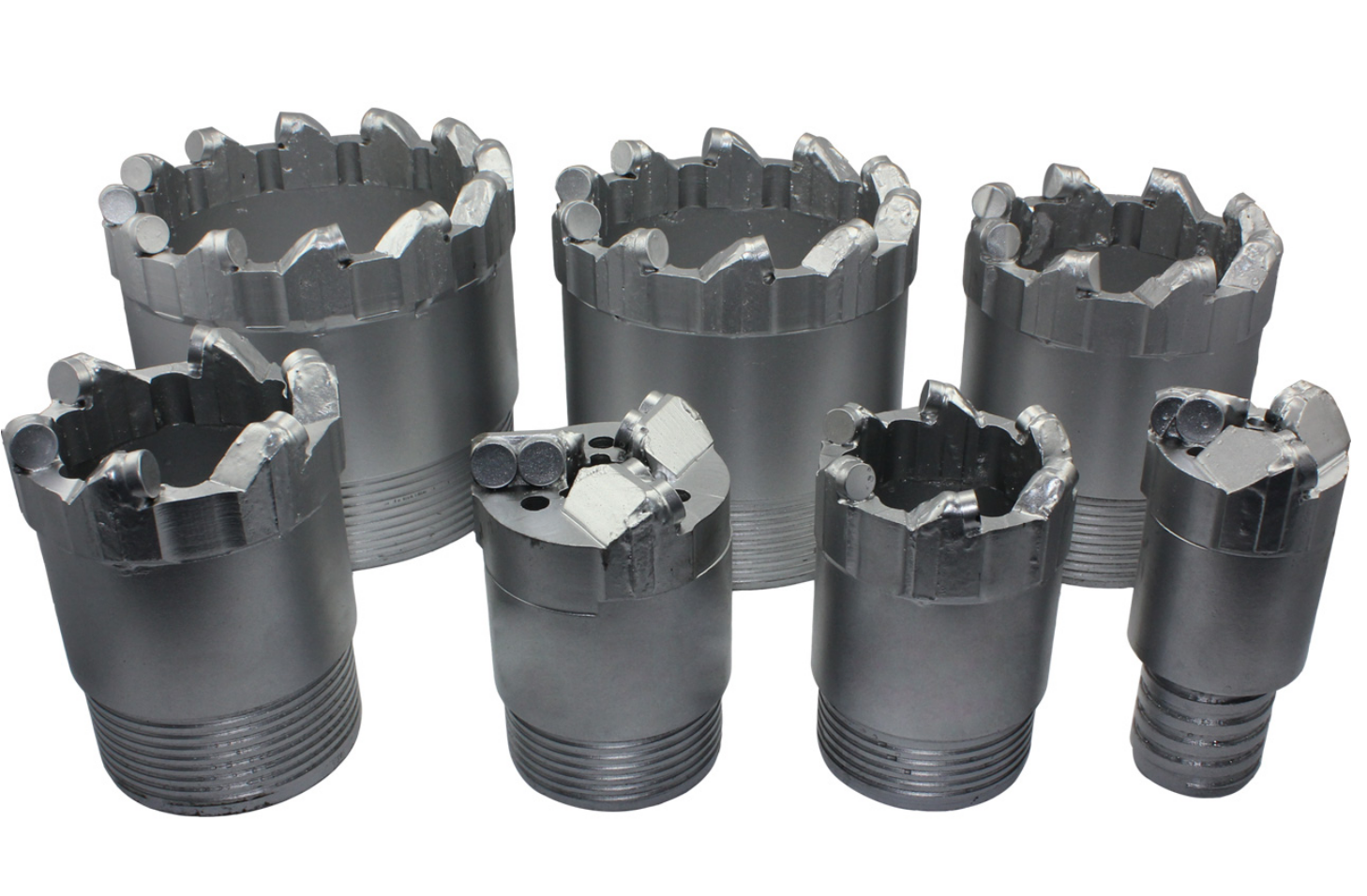
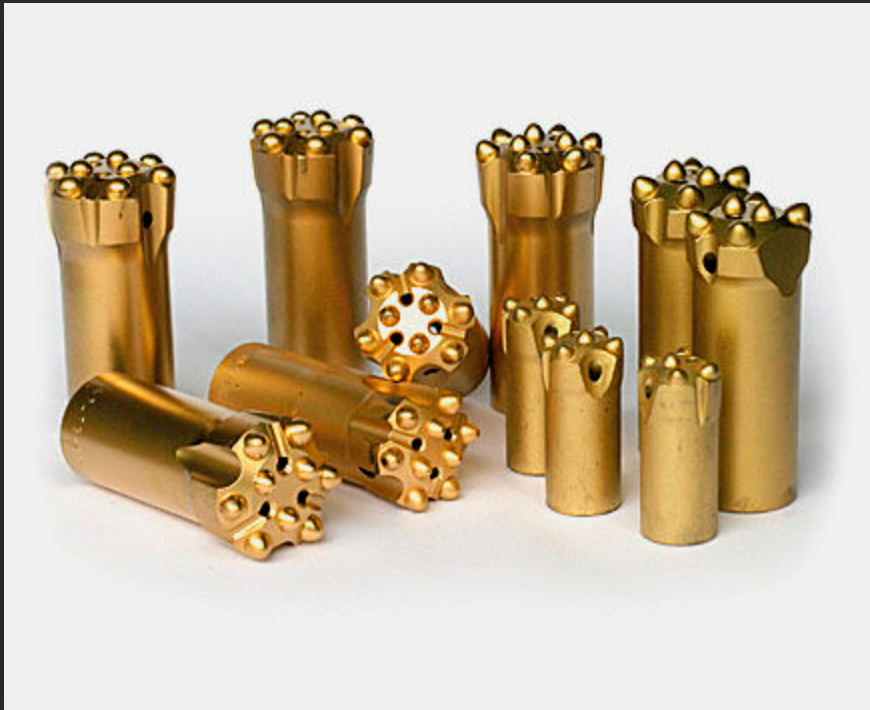
Cutting materials: diamond's hardness advantage — Diamond is the hardest natural material (Mohs hardness 10). Coring bits use diamond in three forms:
| Type | Features | Suitable Formation |
|---|---|---|
| Synthetic single-crystal diamond | Extremely hard, large particles | Extremely hard, highly abrasive rock |
| Impregnated diamond | Diamond particles evenly distributed in matrix, self-sharpening | Hard, dense, abrasive rock |
| PDC | Diamond layer + carbide substrate — hardness and toughness | Soft to medium-hard rock |
Body types: matrix vs. steel:
| Body Type | Features | Suitable Conditions |
|---|---|---|
| Matrix body | Excellent wear resistance, strong erosion resistance | Hard, dense, stable formations |
| Steel body | Good impact resistance, high toughness | Fracture zones, mixed soft/hard, fractured formations |
Compared to ordinary carbide bits, diamond coring bits have clear advantages:
| Comparison | Ordinary Carbide Bit | Diamond Coring Bit |
|---|---|---|
| Breaking method | Full-face | Ring-shaped coring |
| Can obtain core? | No | Yes |
| Life (same formation) | Baseline | 10x or more |
| Drilling efficiency | Average | High |
| Formation information | None | Complete core, rich info |
| Underground safety | Standard | Explosion-proof/anti-static available |
Additionally, some diamond coring bit models have explosion-proof and anti-static properties — fully compliant with coal mine safety regulations. This is a core advantage that ordinary bits cannot replace.
Diamond coring bits are used throughout the coal mine lifecycle:
Coalfield exploration stage — Before mine construction, cores are needed to determine coal seam thickness, number, dip; coal quality (ash, volatiles, calorific value); geological structures (faults, folds, collapse columns); and roof/floor rock types and stability. This information guides mine design, resource assessment, and mining plans.
Underground safety stage — During production, diamond coring bits are widely used for: gas drainage holes (core testing for gas content and pressure), water exploration holes (identifying aquifer location, water volume, pressure — following the "probe before excavation" principle), and coal seam water injection holes (assessing permeability to optimize injection and reduce dust).
Background: A new mine in Shanxi, in the Qinshui coalfield, designed capacity 3 million tons/year. Before construction, detailed exploration was needed to determine the main coal seam (No. 3) thickness, structure, and roof/floor characteristics.
Formation: Target coal seam buried at 480–520 meters. Overlying strata are mainly sandstone and sandy mudstone, with local conglomerate lenses — highly abrasive. Expected coal seam thickness 5.5–6.2 meters with one 0.3-meter partings.
Drilling plan: Three coring holes, 520–560 meters deep, final diameter 75 mm, core diameter 42 mm. Φ75 mm matrix-body impregnated diamond coring bit selected.
Process: ZK01 — light weight, slow speed for break-in (8–10 kN, 280 r/min) for 2 meters, then increased to normal (15–18 kN, 400 r/min). At 485 meters, entered coal seam — 6.1-meter core, recovery 94%. ZK02 — encountered conglomerate lens. Operator reduced weight (12 kN), increased speed slightly (450 r/min) — impregnated bit's self-sharpening passed through without damage. ZK03 — for fault verification. At 510 meters, encountered fracture zone — reduced weight to 8 kN, increased pump rate to 120 L/min — successfully retrieved fractured core, confirming fault location and zone width.
Results:
Total footage: 1,620 meters (three holes)
Max single-bit footage: 610 meters (ZK02)
Average core recovery: 92.5% (required ≥85%)
Bit consumption: 4 bits total for 3 holes (1 spare, 3 actually used)
Comparison: ordinary carbide coring bits would need an estimated 12–15 bits — 1/4 to 1/3 the life
Value: Precise coring confirmed No. 3 seam average thickness 5.8 meters, identified partings distribution, corrected the geological model — saving about 20 million yuan in invalid roadway excavation.
Background: A high-gas mine in Guizhou. Main coal seam gas content reached 18–22 m³/t — far above the safety limit (8 m³/t). Surface + underground pre-drainage was needed before mining.
Challenges: Soft coal, prone to hole collapse; high gas pressure (up to 1.2 MPa) — core retrieval must prevent blowouts; precise measurement of gas content and decay coefficient needed to guide drainage hole layout.
Drilling plan: 12 gas parameter holes in the transport and return airways. Hole depth 120–180 meters, diameter 94 mm, core diameter 63 mm. Φ94 mm steel-body PDC coring bit selected (soft to medium-hard coal, good impact resistance).
Process: First group (4 holes) — weight 12–15 kN, speed 350 r/min, pump rate 80 L/min — successfully retrieved intact coal core, 1.2–1.8 meters per run. In soft coal layers, weight reduced to 8 kN to prevent "over-biting" and core blockage. After retrieval, cores were immediately sealed in desorption canisters for on-site gas measurement.
Results:
Holes completed: 12, total footage 1,860 meters
Coring runs: 86, successful core in 83 runs
Average core recovery: 88% (over 82% in soft coal)
Average bit life: 310 meters (PDC bit)
Gas content range: 16.8–21.5 m³/t, average 19.2 m³/t
Value: Core data optimized drainage hole layout (hole spacing reduced from 8 m to 6 m, drainage time extended from 6 to 8 months). After drainage达标, face gas concentration dropped from 0.8% to below 0.3% — safe excavation with no gas exceedance incidents.
Background: A mine in Shandong with multiple aquifers. The Ordovician limestone floor aquifer had water pressure up to 3.5 MPa — multiple water inflow warnings. Strict "probe before excavation" required water exploration holes before roadway advance.
Challenges: Need accurate identification of aquifer location, thickness, lithology, and fractures; high water pressure requires blowout prevention; holes must penetrate coal seam floor into Ordovician limestone — severe soft/hard alternation.
Drilling plan: 5 water exploration holes in the heading face. Depth 80–120 meters, terminating 5–10 meters into the Ordovician limestone. Φ75 mm steel-body impregnated diamond coring bit selected (for soft/hard alternation, impact resistance).
Process: Through floor (mudstone, siltstone) — moderate weight (12 kN), 300 r/min. Before entering Ordovician — reduced weight to 8 kN, closely monitored pump pressure and return flow. Successfully retrieved limestone core (fractured, with dissolution vugs) — confirmed aquifer at 92–98 meters. Based on fracture intensity, identified high-yield zone — implemented pre-grouting.
Results:
Holes completed: 5, total footage 520 meters
Coring runs: 32, successful in 30 runs
Average core recovery: 86%
Bit consumption: 2 bits for 5 holes (first bit 280 meters, then replaced)
Aquifer identification accuracy: 100% (verified by subsequent grouting)
Value: Accurate aquifer identification guided targeted grouting — preventing a potential water inrush during excavation. Estimated direct economic loss avoided over 50 million yuan — more importantly, lives saved.
Select cutting type by formation:
| Formation | Recommended Bit | Reason |
|---|---|---|
| Soft to medium-hard (mudstone, siltstone, low-medium coal) | PDC bit | High cutting efficiency, good impact resistance |
| Hard, highly abrasive (sandstone, conglomerate, quartzite) | Impregnated diamond | Self-sharpening, long life |
| Fracture zones, soft/hard alternation | Steel-body bit | High impact resistance, not brittle |
Parameter control:
New bit break-in: light weight, slow speed (60–70% normal weight, 50–60% normal speed) for 1–2 meters.
In fracture zones: reduce weight (50–60% normal), increase pump rate (20–30%) — prevent bit damage and core blockage.
Prevent mudding: increase pump rate in soft formations to keep cutters clean.
Regular inspection: Check bit wear after each run (diameter wear, cutter condition, body erosion). Replace when PDC cutters are chipped or impregnated layer is worn flat. Track cumulative footage per bit.
As coal mining extends deeper (eastern China mines exceed 1,000 meters), diamond coring bits are upgrading:
More wear-resistant — new impregnated formulations balancing diamond concentration and matrix wear resistance.
More efficient — optimized hydraulics for better chip removal and cooling.
Smarter — embedded sensors for real-time weight, torque, temperature monitoring.
More adaptable — specialized coatings and matrix materials for deep, high-pressure, high-temperature, corrosive environments.
The small bit carries a big mission for coal mine safety. The diamond coring bit — with its unique "drill while coring" advantage and strong formation adaptability — serves as the "eyes" of coal mine geological exploration and underground safety. From precise coal seam coring in the Qinshui coalfield of Shanxi, to gas parameter measurement in a high-gas mine in Guizhou, to aquifer identification in a complex hydrogeology mine in Shandong — every case proves that this "underground scout" uses real core data to help workers see the true underground picture. As coal mining extends deeper, this tool continues to upgrade — becoming more wear-resistant, more efficient, and better adapted to complex formations — continuously safeguarding efficient and safe coal resource extraction.
 RELATED
This website uses cookies to ensure you get the best experience on our website.





 Phone
Phone E-mail
Comment
(0)